
Comparing PPP Models: BOT, BOOT, DBFOM, and More
Choosing a public-private partnership (PPP) model affects who designs, finances, builds, operates, and maintains an infrastructure asset—and who carries the risks when plans change. BOT, BOOT, DBFOM, and DBFO all combine public and private responsibilities, but they differ in scope, ownership arrangements, and the way a contract allocates performance obligations.
For a public authority preparing a tender, model names are a starting point, not a complete specification. The concession agreement, local law, payment mechanism, and project documents ultimately define each party’s rights and duties.
What PPP models define—and why the choice matters
PPP models define how a public authority and private partner divide project delivery, financing, operations, ownership, and risk over a contract period. The choice matters because it shapes tender requirements, private-sector pricing, service standards, and the government’s long-term obligations.
A PPP is a contractual arrangement for delivering a public asset or service, often over several years. In many projects, a private consortium raises project financing and repays its lenders and investors through government payments, user charges, or a combination of the two. Private financing alone does not make a project a PPP; the allocation of responsibilities and risks is central.
The model influences questions a tender must answer:
- Scope: Is the private partner responsible for design and construction, or only later stages?
- Finance: Must it arrange capital and bear financing risks such as interest-rate or refinancing exposure?
- Service delivery: Who operates and maintains the asset, and against what performance standards?
- Ownership: Who holds legal title during the contract, and what happens at expiry?
- Risk allocation: Which party can best manage construction delays, cost overruns, demand changes, or lifecycle maintenance?
A useful way to assess a proposed structure is the lifecycle-responsibility test: trace each obligation from design through handback, then check whether the party accountable also has the authority and incentive to manage it. Bundling can improve coordination, but it can also make bids more complex and reduce flexibility if the public authority later needs to change the service.
BOT and BOOT: similar structures, different ownership terms
BOT and BOOT both typically involve a private partner building and operating an asset before transferring it to the public authority. The key distinction is that BOOT explicitly includes private ownership during the concession, while BOT ownership depends on the contract and governing law.
Under a Build-Operate-Transfer (BOT) arrangement, the private partner generally builds the facility, operates it for an agreed period, and transfers it at the end. The concession agreement sets out operating standards, payment rights, maintenance duties, and handback requirements. BOT is often used for facilities such as transport links, water infrastructure, and power projects.
Under Build-Own-Operate-Transfer (BOOT), the private partner typically owns the asset during the concession as well as building and operating it. At the end of the term, ownership transfers to the public sector or another designated owner. The ownership period can support the private partner’s ability to control and finance the asset, but it may also require clear rules on regulation, access, asset condition, and public-service continuity.
The labels are not universal. A BOT contract may give the private partner ownership rights, while a BOOT project may place some assets or land under public ownership. Tender documents should therefore state exactly when legal and beneficial ownership changes, who bears asset-related liabilities, and what condition the asset must meet at transfer.
DBFOM and DBFO: integrating delivery, finance, and operations
DBFOM and DBFO bundle design, construction, and private financing with operational responsibilities, while DBFOM explicitly includes maintenance. This integrated scope can align construction decisions with long-term performance, provided the contract defines measurable service standards and enforceable remedies.
Design-Build-Finance-Operate-Maintain (DBFOM) assigns the private partner responsibility for designing and building the asset, arranging financing, operating it, and maintaining it for a defined period. The authority commonly retains ownership, though ownership arrangements vary. Payments may depend on availability or service performance, so poor upkeep or failure to meet standards can reduce the private partner’s revenue.
Design-Build-Finance-Operate (DBFO) has a similar bundled structure but does not name maintenance as a separate responsibility. That does not necessarily mean the private partner has no maintenance duties: the contract may include them within operations or define them elsewhere. Buyers should inspect the scope and performance schedules rather than infer obligations from the acronym.
These models can encourage lifecycle thinking. A partner responsible for long-term operation and maintenance may have a reason to choose durable materials and systems that are easier to service. The trade-off is a more demanding procurement: bidders must price long-term obligations, and the authority needs the expertise to monitor performance throughout the contract. Changes in user needs can also be harder to accommodate when responsibilities are tightly bundled.
Other common PPP and concession structures
Other PPP and concession structures divide project duties in different ways, including arrangements focused on rehabilitation, leasing, or operation of existing assets. Because terminology varies by jurisdiction, compare the actual contract scope and risk allocation rather than relying on a model name.
Common labels include Build-Transfer (BT), where a private partner builds an asset and transfers it to the authority, and Build-Transfer-Operate (BTO), where transfer occurs before private operation. In a rehabilitation, operate, and transfer arrangement, the private partner upgrades an existing facility, operates it for a term, then hands it back. Lease or operate-and-maintain contracts may cover service delivery without requiring the partner to finance major new construction.
A concession agreement can sit at the center of these arrangements, granting rights to operate an asset or provide a service under specified conditions. Concessions may place demand risk on the private partner when revenue depends on user charges, though contracts can also include public payments or other protections. Each allocation has consequences: transferring demand risk can sharpen incentives, but it may raise bid prices or make financing difficult when usage is uncertain.
Authorities should check local regulations and standard contract definitions before choosing a label. The same acronym can carry different implications across countries, sectors, and procurement frameworks.
Compare models by responsibilities, ownership, and risk
The main differences among PPP models are the scope of private responsibilities, ownership during the contract, and the timing and conditions of asset transfer. The table below gives a practical starting point; the signed contract, not the acronym, controls.
| Model | Typical private scope | Financing | Operations and maintenance | Ownership and transfer |
|---|---|---|---|---|
| BOT | Build, then operate | Often private project financing | Operations included; maintenance depends on contract | Transfer at end; ownership during term varies |
| BOOT | Build, own, operate | Often private project financing | Operations included; maintenance defined in contract | Private ownership during term is explicit; transfer at end |
| DBFOM | Design, build, finance, operate, maintain | Private financing typically arranged | Both named as private responsibilities | Often public ownership, but contract-specific; handback terms apply |
| DBFO | Design, build, finance, operate | Private financing typically arranged | Operations included; maintenance must be checked in scope | Ownership and any transfer are contract-specific |
Across all models, risk allocation should follow practical control. A private partner may be better placed to manage design coordination or construction delivery; the public authority may retain policy, land-acquisition, or regulatory risks. Demand risk, force majeure, change in law, and financing exposure need explicit treatment rather than assumptions based on the model name.
How to select a model for a project or tender
To select a PPP model, define the service outcome first, test which party can manage each material risk, and then choose a contract scope that the market can finance and the authority can oversee. A suitable structure depends on project needs, public-sector capacity, risk appetite, and long-term service requirements.
Use this sequence during project preparation and tender design:
- Define the public need. Specify the service, capacity, quality, and availability required, rather than starting with a preferred acronym.
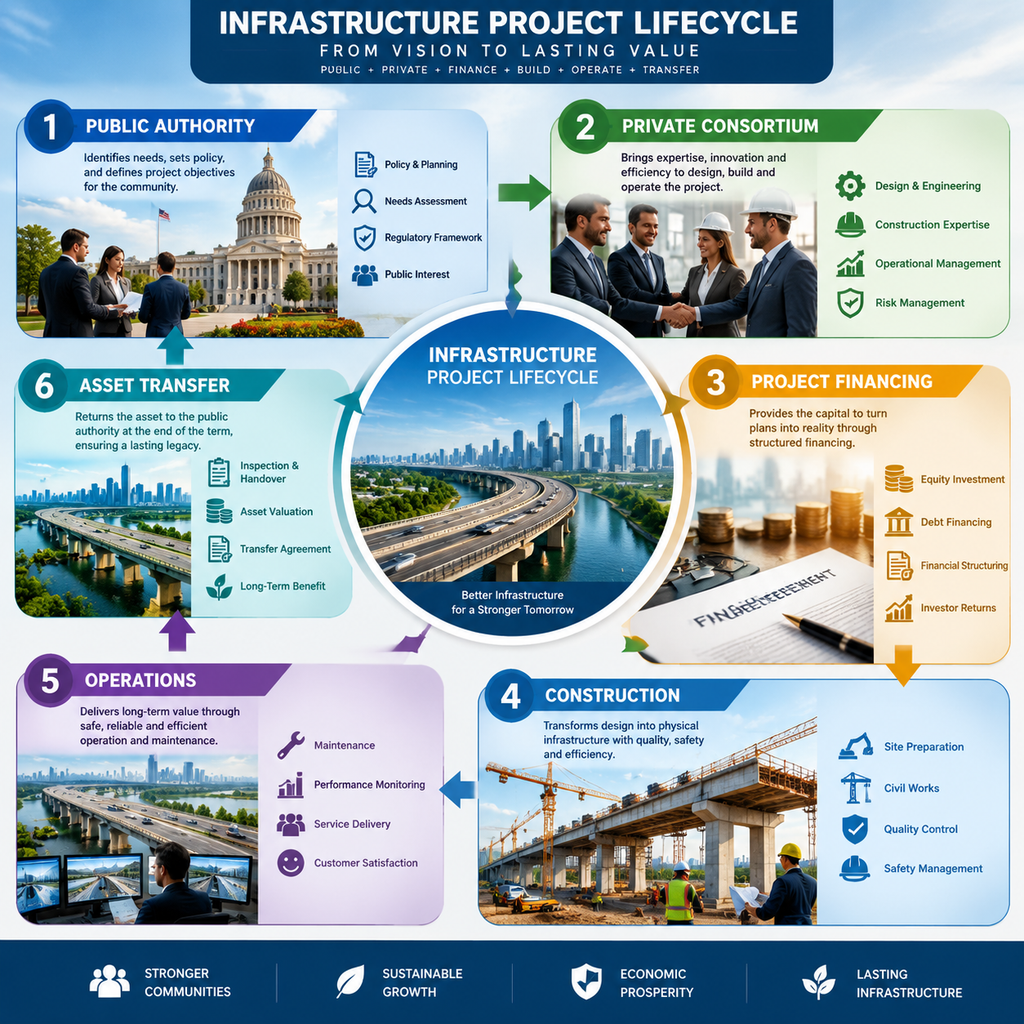
- Map lifecycle tasks. Identify who will design, build, finance, operate, maintain, and eventually receive the asset.
- Allocate manageable risks. Place each risk with the party best able to control or absorb it. Avoid transferring risks that bidders cannot price reliably.
- Confirm the payment model. Compare availability payments, user charges, and mixed revenue against demand forecasts and affordability limits.
- Test market interest and oversight capacity. Consider whether qualified bidders can deliver the package and whether the authority can monitor outputs for the full term.
- Set transfer and evaluation rules. Define asset condition at handback and use tender evaluation criteria that cover whole-life cost, technical quality, financing credibility, and service performance.
For a new facility requiring long-term maintenance, DBFOM may provide a coherent lifecycle package if the authority can monitor service levels. A project with a clear operating concession and a defined handback may fit BOT or BOOT, depending on ownership needs. Neither structure is automatically superior; a tightly bundled model can transfer coordination risk while increasing procurement complexity and limiting later flexibility.
Before issuing a tender, review local law, land and asset ownership rules, affordability, contingent public liabilities, and the proposed concession agreement. Clear definitions and realistic risk allocation help bidders price consistently and give the authority a stronger basis for comparing offers.
Frequently asked questions
How do BOT and BOOT differ? Both commonly cover building and operating an asset before transfer. BOOT explicitly provides for private ownership during the concession; BOT ownership terms depend on the contract and local law.
Is DBFOM the same as DBFO? No. DBFOM names maintenance as part of the private scope, while DBFO does not. A DBFO contract may still include maintenance under its operations obligations, so check the detailed scope.
Who owns the asset during a PPP contract? Ownership depends on the model, the concession agreement, and local law. The public authority may retain title, or a private partner may own the asset for a defined period before transfer.
Which PPP model is best for an infrastructure project? There is no universally best model. Select one based on required services, lifecycle responsibilities, risk allocation, market capacity, affordability, and the authority’s ability to manage the contract.