
Bid Preparation for Large-Scale Infrastructure Projects: A Step-by-Step Guide

Bid preparation for a large-scale infrastructure project requires much more than producing a competitive price. A successful submission connects the tender documents, technical solution, commercial offer, financing plan, risk allocation, and formal compliance requirements into one credible response.
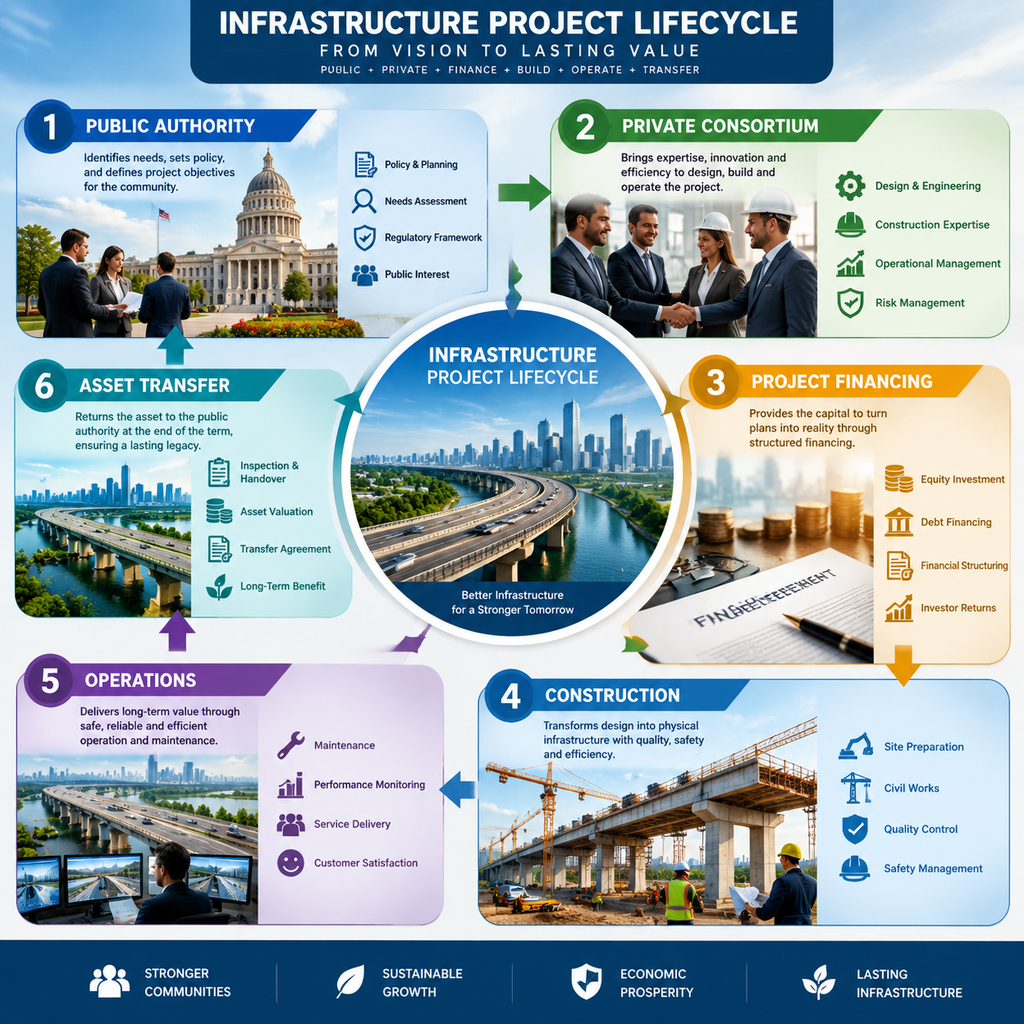
For a public-private partnership (PPP), the challenge is broader still. Bidders must demonstrate that the consortium can finance, design, build, operate, maintain, and sometimes hand back the asset over a long contract term. The following workflow provides a practical route from the first RFP review to controlled submission.
Understand the Tender and PPP Procurement Framework
To understand a tender, first establish what the Request for Proposal (RFP) requires, how the project will be evaluated, and which contractual, technical, and eligibility conditions are mandatory. This initial review defines the bid strategy and prevents teams from solving the wrong problem.
Begin by creating a controlled register of all tender documents, including the RFP instructions, draft project agreement, technical specifications, output requirements, schedules, pricing forms, data-room materials, clarification notices, and addenda. Record the document version, issue date, review status, and owner. Only the latest procuring-authority issue should guide the final submission.
Next, examine the procurement framework. Confirm the bid timetable, clarification process, submission method, language rules, validity period, bid security requirements, and permitted communication channels. Requirements vary by jurisdiction, project type, and procuring authority, so bidders should verify the applicable procurement law and obtain appropriate local legal advice. Resources such as the World Bank PPP Resource Center can provide useful background, but the project’s own tender documents remain controlling.
Review the project scope through a lifecycle lens:
- What must be designed, constructed, commissioned, operated, and maintained?
- Which land, permits, utilities, traffic interfaces, or existing assets must the project team manage?
- What service levels, availability standards, output specifications, or key performance indicators apply?
- What are the payment, tariff, revenue, concession, or availability-based mechanisms?
- Which prequalification requirements must be evidenced again at the RFP stage?
Pay particular attention to the draft contract. In a PPP, the contract determines lifecycle responsibilities, termination consequences, insurance obligations, refinancing provisions, handback standards, change procedures, and risk allocation. A technically attractive proposal can become commercially unviable if the bidder overlooks an onerous interface or performance obligation.
Build a Bid Compliance and Responsibility Matrix
A bid compliance matrix maps every tender requirement to evidence, an accountable owner, an approval route, and a submission location. It is the central control document for preventing omissions, contradictory answers, and avoidable disqualification.
Convert the RFP into individual requirements rather than treating each volume as one task. A useful matrix contains:
- Requirement reference and exact wording
- Mandatory or discretionary status
- Required response, form, certificate, or attachment
- Responsible author and supporting contributors
- Technical, commercial, legal, financial, or governance classification
- Internal review date and final approval date
- Submission volume, page limit, format, and file name
- Evidence status, open issue, assumption, and clarification reference
Link each requirement to a named person, not merely a department. The engineering lead may own performance requirements, while the finance lead owns the financial model and funding assumptions. Legal counsel may control departures from the draft agreement, and the bid director should own cross-volume consistency.
Use review gates. At the first gate, confirm that every requirement has an owner. At the second, test whether each response contains evidence rather than promises. At the third, check that the final answer matches the pricing forms, technical proposal, consortium commitments, and contract position.
Keep an assumptions register beside the matrix. Each assumption should state its source, financial effect, technical consequence, owner, and fallback position. This makes uncertainty visible and gives the team a clear basis for clarification questions.
Form the Bid Team, Consortium, and Delivery Network
Form the bid team around the project lifecycle, with clear authority across the sponsor, consortium members, advisers, and subcontractors. Early governance reduces duplicated work and exposes gaps between what the bid promises and what the delivery network can perform.
A typical structure includes a bid director, project director, technical lead, construction lead, operations and maintenance lead, commercial manager, financial model lead, legal counsel, insurance adviser, tax adviser, sustainability specialist, and document controller. The exact structure depends on the asset and procurement model.
For a consortium, agree responsibilities before detailed drafting begins. The consortium agreement or related teaming arrangements should address workshare, exclusivity, confidentiality, intellectual property, bid costs, governance, voting rights, liability, replacement rights, and negotiations after award. Participants should also confirm parent-company support, guarantees, minimum financial capacity, and any restrictions on changes in ownership.
Subcontractors can add valuable construction capability, specialist systems, operations expertise, or local knowledge. However, their commitments must be documented and aligned with the prime contract. Request evidence of capacity, relevant experience, safety performance, insurance, bonding ability, and availability for the proposed delivery period.
Set up a weekly decision log and an issues register. Escalate matters that affect price, programme, compliance, risk allocation, or the credibility of the proposed solution. A bid team that resolves interfaces early will usually produce a more coherent response than a larger team working without decision rights.
Develop the Technical and Methodology Proposal
The technical proposal should show how the bidder will deliver the required outputs throughout the asset lifecycle, using evidence, measurable commitments, and a methodology that matches the project’s risks and constraints.
Start with a compliance-based outline. Each major section should answer a corresponding evaluation criterion and point to supporting evidence. Explain the proposed design basis, construction sequence, temporary works, commissioning approach, operations model, maintenance regime, and performance monitoring process.
Cover the full delivery lifecycle
- Design: Explain design governance, interfaces, constructability reviews, approvals, digital engineering, and design assurance.
- Construction: Set out logistics, programme controls, procurement packages, site access, utilities, traffic management, and commissioning dependencies.
- Operations and maintenance: Describe staffing, asset management, preventive maintenance, spares, response times, and lifecycle replacement planning.
- Quality and safety: Provide quality plans, inspection and test procedures, incident controls, training, and reporting arrangements.
- Sustainability: Address energy use, emissions, resilience, resource efficiency, climate adaptation, community impacts, and applicable environmental obligations.
A strong methodology distinguishes between a proposed solution and a measurable control. Instead of stating that construction will be well managed, identify the schedule baseline, reporting cadence, hold points, approval authority, and recovery procedure for delay. Tie commitments to the performance regime and ensure the commercial offer can support them.
Review all interfaces with the authority, utility providers, existing operators, lenders, and other contractors. These boundaries often create more delivery risk than the core engineering design.

Prepare the Commercial and Financial Offer
The commercial and financial offer must translate the technical solution into a credible price, payment mechanism, funding plan, and risk position. It should be competitive while remaining consistent with the delivery obligations and the financial model.
Build the cost estimate from a documented work breakdown structure. Include design, construction, land and permitting interfaces, utilities, insurance, financing fees, taxes, operations, maintenance, lifecycle renewals, contingency, overhead, and bid-specific costs where relevant. Record the basis for quantities, rates, escalation, productivity, programme, and foreign-exchange assumptions.
For a PPP, determine how the project generates or receives revenue. The mechanism may involve availability payments, user charges, shadow tolls, direct government payments, or a combination. Model deductions, indexation, performance requirements, reserve accounts, debt service, distributions, refinancing, termination payments, and handback obligations according to the tender documents.
The financial model should be independently checked before submission. Test formula integrity, circularity, tax treatment, debt sculpting, cash waterfalls, scenario switches, and consistency between the model and the financial forms. Run downside cases for construction delay, cost growth, interest-rate changes, demand variation, operational underperformance, and delayed payments.
Value for money is broader than the lowest initial price. Procuring authorities may assess affordability, lifecycle cost, service quality, risk transfer, resilience, and financing credibility. Choosing a lower capital cost can mean accepting higher maintenance exposure or weaker operational resilience, so the bid should explain why its whole-life proposition is reliable.
Identify Risks and Strengthen the Bid Strategy
Risk review should identify what could prevent delivery, quantify its effect where possible, and assign each risk to the party best able to manage it. A disciplined risk process strengthens both the bid strategy and the proposed contract position.
Create a risk register covering:
- Technical design uncertainty and site conditions
- Construction productivity, materials, logistics, and programme delay
- Land acquisition, utilities, interfaces, and approvals
- Demand, tariff, inflation, foreign exchange, and interest rates
- Legal, regulatory, tax, permitting, and policy changes
- Operations, maintenance, safety, environmental, and handback obligations
- Consortium performance, subcontractor failure, and supply-chain disruption
For each risk, record the cause, event, consequence, probability, financial exposure, mitigation, owner, and residual position. Then compare the proposed risk allocation with the draft project agreement. If the contract transfers a risk that the private party cannot price or control, the bidder may need a clarification, qualification where permitted, technical mitigation, contingency, or financing adjustment.
Do not hide material uncertainty inside a broad contingency. Separate known quantities, design development, market volatility, and unpriced contractual exposure. This gives decision-makers a clearer view of whether the bid is genuinely competitive.
Finally, map the strategy to the bid evaluation criteria. Rank the criteria by importance, identify the evidence required for each, and test whether the response is easy for evaluators to score. A persuasive proposal makes the evaluator’s job straightforward: requirement, solution, evidence, benefit, and contractual commitment.
Conduct Final Reviews and Submit a Controlled Bid
Begin the final bid review early enough to correct substantive issues, then use a controlled submission process to verify compliance, consistency, approvals, and delivery. The last review should confirm the bid can be submitted exactly as required, not merely that the writing is complete.
Use separate reviews for different failure modes:
- Compliance review: Check forms, signatures, certificates, page limits, file formats, bid security, validity periods, eligibility evidence, and mandatory declarations.
- Technical review: Confirm that the methodology answers every requirement and that programme, resources, safety, quality, sustainability, and performance commitments are achievable.
- Commercial review: Reconcile pricing schedules, qualifications, assumptions, contract departures, taxes, insurance, contingencies, and consortium commitments.
- Financial review: Reconcile the financial model, funding plan, payment mechanism, sensitivity cases, and required financial offer.
- Executive review: Obtain formal approval of price, risk appetite, legal position, guarantees, and submission authority.
Run a final consistency check across every volume. A construction date in the technical proposal must match the financial model. Staffing levels must align with operations costs. Performance guarantees must match the contract response. Use locked templates, controlled file names, change logs, and a single submission repository.
Confirm clarification responses and addenda have been incorporated. Complete a dry run of the electronic submission, including authentication, upload limits, virus scanning, digital signatures, and receipt generation. Do not wait until the deadline day to discover that a file is corrupted or an authorised signatory is unavailable.
Submit with sufficient time for technical failure and retain the official receipt, final file set, approval record, and version history. After submission, maintain a clean audit trail for clarification meetings, best-and-final-offer stages, negotiations, and any permitted updates.
Frequently Asked Questions
What is the first step in preparing an infrastructure project bid?
The first step is to review and control the RFP and all tender documents. Confirm scope, eligibility, deadlines, evaluation criteria, contract structure, submission rules, and PPP lifecycle obligations before assigning detailed drafting work.
What documents are typically required in a PPP tender submission?
Typical documents include eligibility and prequalification evidence, technical and methodology proposals, financial forms, a financial model, consortium and subcontractor commitments, legal declarations, bid security, insurance information, financing evidence, and signed forms. The exact list depends on the RFP and jurisdiction.
How can bidders avoid non-compliance or disqualification?
Use a bid compliance matrix, assign every requirement to an accountable owner, track addenda and clarifications, complete independent reviews, obtain required signatures, and submit only the approved file set through the specified channel.
What should a bid compliance matrix include?
It should include the requirement reference, exact wording, response or evidence needed, owner, contributors, approval route, deadline, submission location, format restrictions, status, assumptions, and clarification history.
How early should the final bid review begin?
Begin the final integrated review before documents are considered finished. The timing depends on bid complexity, but large infrastructure and PPP submissions need enough time for technical, commercial, financial, legal, executive, and electronic submission checks, followed by correction and approval cycles.
Disciplined bid preparation turns a complex infrastructure tender into a sequence of controlled decisions. When requirements, evidence, responsibilities, pricing, financing, risk allocation, and approvals remain connected from the first review to submission, the final bid becomes easier to evaluate and more credible to the procuring authority.