

Legal Frameworks Governing International Infrastructure Tenders: What Bidders and Investors Need to Know
Winning an international infrastructure tender requires more than competitive pricing and engineering capacity. The legal landscape surrounding cross-border procurement is layered, sometimes contradictory, and changes depending on who is financing the project. Companies that enter these processes without a clear understanding of the governing frameworks often find themselves disqualified on procedural grounds — or worse, locked in costly disputes years after contract award.
This guide breaks down the key legal instruments, institutional rules, and practical compliance requirements that shape international infrastructure procurement today.
Why Legal Frameworks Matter in International Infrastructure Procurement
Legal frameworks define the rules of the game in international procurement — who can bid, how bids are evaluated, and what remedies exist when things go wrong. For companies pursuing cross-border infrastructure tenders or Public-Private Partnership (PPP) projects, ignoring these frameworks is not a minor oversight. It is a disqualifying risk.
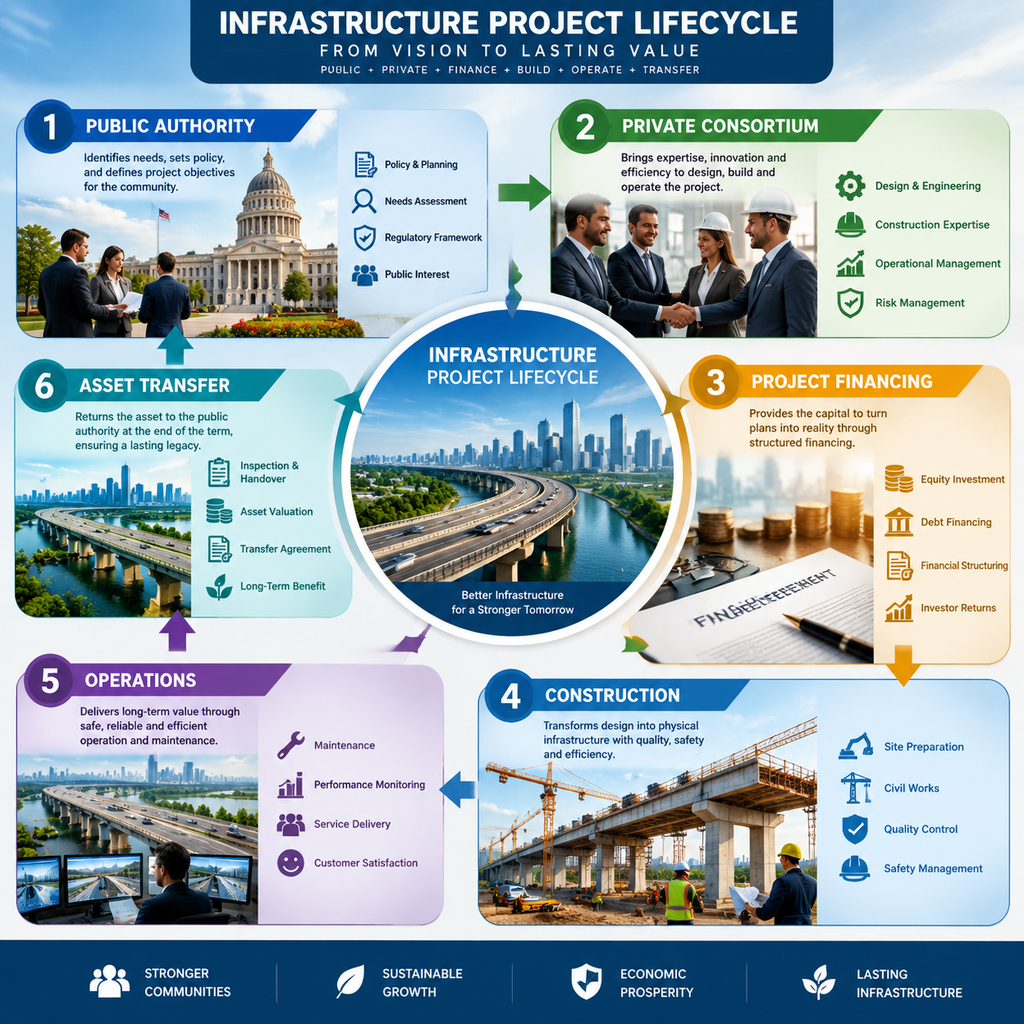
Infrastructure projects are uniquely exposed to legal complexity. They involve large capital commitments, long contract durations (often 20–30 years for concessions), multiple jurisdictions, and a mix of public and private actors. A highway project financed by a multilateral development bank, awarded under host-country public procurement law, and structured as a PPP concession may simultaneously be subject to three or four distinct legal regimes.
The practical consequence: a bid that is technically compliant with national law may still be rejected if it fails to meet the financing institution's procurement requirements. Understanding which framework governs which aspect of the process is not a legal formality — it is a prerequisite for participation.
Key International Instruments and Standards
The primary international frameworks shaping infrastructure procurement are the UNCITRAL Model Law on Public Procurement, the WTO Government Procurement Agreement, and the procurement guidelines issued by multilateral development banks. Each has a different scope and a different mechanism of influence.
The UNCITRAL Model Law on Public Procurement is a legislative template developed by the UN Commission on International Trade Law. It is not binding on any country, but it has been adopted — in whole or in part — by dozens of national legislatures as the basis for their domestic procurement systems. Its value lies in standardization: countries that follow UNCITRAL principles create procurement environments that are more predictable for international bidders.
The WTO Government Procurement Agreement (GPA) operates differently. It is a binding plurilateral agreement among WTO members that commits signatory governments to open their procurement markets to suppliers from other GPA parties. For infrastructure tenders above specific financial thresholds, GPA signatories must apply non-discrimination principles and transparent procedures. As of 2024, the GPA covers 48 WTO members, though many emerging economies — where significant infrastructure investment is concentrated — remain outside its scope.
These two instruments set the normative baseline. In practice, however, the rules that matter most on any given project are often those imposed by whoever is providing the financing.
The Role of Multilateral Development Banks in Setting Procurement Rules
When a project is financed by a multilateral development bank, the MDB's procurement framework takes precedence over national rules — and this is non-negotiable. The World Bank Procurement Framework, the Asian Development Bank's procurement policy, and the EBRD's procurement policies each impose their own requirements on borrower governments and, by extension, on bidders.
The World Bank's current procurement framework, in force since 2016, introduced a principles-based approach organized around value for money, economy, integrity, fit for purpose, efficiency, transparency, and fairness. For large infrastructure contracts, this typically means open international competitive bidding with detailed qualification criteria, mandatory disclosure of evaluation results, and post-award publication of contract details.
What this means for bidders: a company that has never worked on a World Bank-financed project should expect a significantly more rigorous documentation process than standard national tenders. Bid security requirements, anti-corruption declarations, beneficial ownership disclosures, and environmental and social safeguard commitments are standard. Failure to provide any of these — even if they are not required under local law — results in disqualification.
The ADB and EBRD follow broadly similar principles but with regional variations. EBRD-financed projects in Eastern Europe and Central Asia, for instance, often include specific requirements around environmental impact assessment and labor standards that reflect the bank's mandate beyond pure financial returns.
National Laws vs. International Standards — Navigating the Overlap
The relationship between host-country legislation and international procurement standards is the most common source of confusion for companies entering new markets. National law governs the legal validity of contracts and the authority of procuring entities; international frameworks govern the process by which those contracts are awarded. The two do not always align.
Consider a practical scenario: a government ministry awards a road concession following World Bank procurement procedures. The concession agreement is then executed under national law. If a dispute arises over the award process, the bidder may have remedies under the bank's complaint mechanism — but enforcement of those remedies ultimately depends on what national administrative law permits. Legal due diligence at the national level is therefore not optional, even on MDB-financed projects.
Key areas where conflicts commonly arise include:
- Qualification criteria that are stricter under national law than MDB guidelines require
- Mandatory local content requirements that conflict with GPA non-discrimination obligations
- National audit requirements that impose additional disclosure obligations on foreign bidders
- Restrictions on foreign ownership of project companies that affect PPP structuring
The safest approach is to treat national law and international standards as additive rather than alternatives. Compliance with the more demanding requirement in each area is generally the correct default position.
PPP-Specific Legal Considerations in Infrastructure Tenders
PPP and concession-based tenders involve a fundamentally different legal structure than standard public works contracts, and the distinction matters from the moment a bid is prepared. In a traditional public works contract, the government pays a contractor to build something. In a concession agreement, the private party finances, builds, operates, and often maintains the asset — recovering its investment through user fees or availability payments over a defined period.
This shift in risk allocation changes everything about the legal framework. The concession agreement itself becomes the central legal instrument, and its terms govern the commercial relationship for decades. Key legal elements that require careful analysis include:
- Risk allocation matrix: which party bears construction risk, demand risk, regulatory risk, and force majeure events
- Revenue support mechanisms: minimum revenue guarantees, viability gap funding, or availability payment structures
- Change-in-law provisions: how the concession responds to legislative or regulatory changes that affect project economics
- Step-in rights: conditions under which the government can take over operations if the concessionaire defaults
- Termination compensation: what the private party receives if the concession is terminated early by either party
Sovereign risk is a particular concern in PPP structures. A government that changes its regulatory framework mid-concession, imposes new taxes, or delays approval processes can materially damage project returns without technically breaching the concession agreement. Experienced PPP bidders treat sovereign risk assessment as a core part of pre-bid due diligence, not an afterthought.
Dispute Resolution Mechanisms in International Infrastructure Contracts
International infrastructure contracts almost universally include arbitration clauses rather than relying on national courts — and for good reason. When a dispute involves a foreign private company and a sovereign government, domestic courts in the host country are rarely a neutral forum.
The standard mechanisms used in international infrastructure contracts include ICC arbitration, LCIA arbitration, and — for disputes involving investment treaty claims — proceedings before the International Centre for Settlement of Investment Disputes (ICSID). ICSID is particularly significant in PPP contexts because it provides a dedicated forum for disputes between foreign investors and host states, with enforcement mechanisms under the ICSID Convention that are recognized in over 160 countries.
Beyond the choice of arbitral institution, the dispute resolution clause in a concession agreement typically addresses:
- Tiered dispute resolution: negotiation, then expert determination, then arbitration
- Seat of arbitration and governing law (which may differ from the host country's law)
- Language of proceedings
- Interim relief mechanisms during pending arbitration
One frequently overlooked point: bilateral investment treaties (BITs) between the investor's home country and the host state may provide additional protections — including the right to bring ICSID claims — independent of what the concession agreement says. Checking applicable BITs before finalizing a project structure is standard practice among sophisticated project sponsors.
Practical Compliance Checklist for International Tender Participation
Before submitting a bid on any international infrastructure tender, companies should work through a structured compliance review. The following checklist covers the core legal and procedural steps that experienced bidders treat as non-negotiable.
- Identify the governing procurement framework: Determine whether the project is subject to MDB rules, WTO GPA obligations, UNCITRAL-based national law, or a combination. Each has different documentation and process requirements.
- Review the host-country legal environment: Assess national procurement law, foreign investment restrictions, local content requirements, and any sector-specific regulations (energy, transport, water) that apply to the project type.
- Analyze the concession agreement or draft contract: For PPP tenders, the draft concession agreement is typically issued with the tender documents. Legal review of risk allocation, termination provisions, and dispute resolution clauses should happen before bid submission, not after.
- Conduct sovereign risk assessment: Review the host country's track record on infrastructure concessions, its credit rating, and any pending regulatory or political changes that could affect project viability.
- Prepare anti-corruption and compliance documentation: MDB-financed projects require explicit anti-corruption commitments. Ensure your company's compliance program meets the standards specified in the tender documents.
- Verify dispute resolution and enforcement options: Confirm applicable BITs, the arbitration clause in the draft contract, and the enforceability of arbitral awards in the host jurisdiction.
- Engage local legal counsel: No international framework substitutes for on-the-ground legal expertise. Local counsel familiar with the procuring entity and the national legal environment is essential for any serious bid.
The investment in pre-bid legal due diligence is consistently underestimated. A thorough legal review before submission prevents disqualification, surfaces deal-breaking risks before capital is committed, and positions the bidder to negotiate contract terms from an informed position.
Frequently Asked Questions
What is the UNCITRAL Model Law and does it apply in every country?
The UNCITRAL Model Law on Public Procurement is a legislative template developed by the UN Commission on International Trade Law to help countries modernize their procurement systems. It is not automatically binding — each country must adopt it through its own legislative process. Dozens of countries have incorporated its principles into national law, but adoption varies widely. Before bidding in any jurisdiction, verify whether and how UNCITRAL principles have been incorporated into local procurement legislation.
How do World Bank procurement rules differ from national procurement laws?
World Bank procurement rules apply specifically to contracts financed by World Bank loans or grants, and they take precedence over national rules in those contexts. They emphasize value for money, transparency, and anti-corruption compliance at a level that often exceeds national requirements. National procurement laws govern all other publicly funded contracts in that country. The key practical difference: World Bank-financed tenders require additional documentation — including beneficial ownership disclosures and environmental compliance certifications — that domestic tenders may not.
What legal documents should be reviewed before bidding on an international infrastructure tender?
At minimum, review the tender documents and instructions to bidders, the draft concession agreement or contract, the applicable procurement framework (MDB guidelines or national law), any sector-specific regulations, and the host country's foreign investment and local content rules. For PPP projects, the draft concession agreement is the most critical document — it defines the commercial and legal relationship for the entire project duration.
How are disputes typically resolved in international PPP contracts?
Most international PPP contracts use tiered dispute resolution: negotiation first, followed by expert determination for technical disputes, and international arbitration as the final step. ICSID arbitration is common when the dispute involves an investment treaty claim against a sovereign government. The seat of arbitration is typically a neutral jurisdiction — London, Paris, Singapore, or Geneva — regardless of where the project is located.
What is the difference between a concession agreement and a standard public works contract?
In a standard public works contract, the government pays a contractor to build infrastructure, retaining ownership and operational responsibility throughout. In a concession agreement, the private party finances, builds, and operates the asset for a defined period — typically 20–30 years — recovering its investment through user fees or government availability payments. The key distinction is risk transfer: concession agreements shift significant financial, operational, and demand risk to the private sector, which is why they require far more detailed legal structuring than conventional procurement contracts.