
Case Study: Successful PPP in Transportation – Key Lessons Learned for Practitioners
Public-Private Partnerships in transportation have delivered some of the most complex infrastructure projects in the world — and some of the most expensive failures. The difference between the two rarely comes down to engineering. It comes down to how the deal was structured, how risk was shared, and whether the parties built in mechanisms to adapt over time. This case study breaks down what a well-executed transportation PPP actually looks like from the inside, and what practitioners can take directly into their next bid or concession evaluation.
What Makes a Transportation PPP "Successful"?
A transportation PPP is successful when it delivers the intended public service on time, remains financially sustainable across the concession period, and satisfies both public users and private investors without requiring repeated government bailouts. That four-part definition matters because most projects optimize for only one or two of these outcomes.
On-time and on-budget delivery is the most visible metric, but it can mask structural problems that surface years later. A toll road opened on schedule but priced out of reach for local users is not a success by any reasonable measure. Equally, a project that generates strong investor returns through opaque contract clauses at the expense of the public authority is a governance failure, regardless of what the financial model says.
For practitioners, the most useful success criteria are:
- Value for Money (VfM) — does the PPP structure deliver better outcomes than conventional public procurement?
- Financial sustainability — can the revenue model cover debt service and operations without extraordinary public support?
- Long-term operability — are performance standards maintained throughout the full concession period, not just at handover?
- Public satisfaction — does the infrastructure serve actual demand patterns, not just projected ones?
Overview of the Case Study: Project Context and Structure
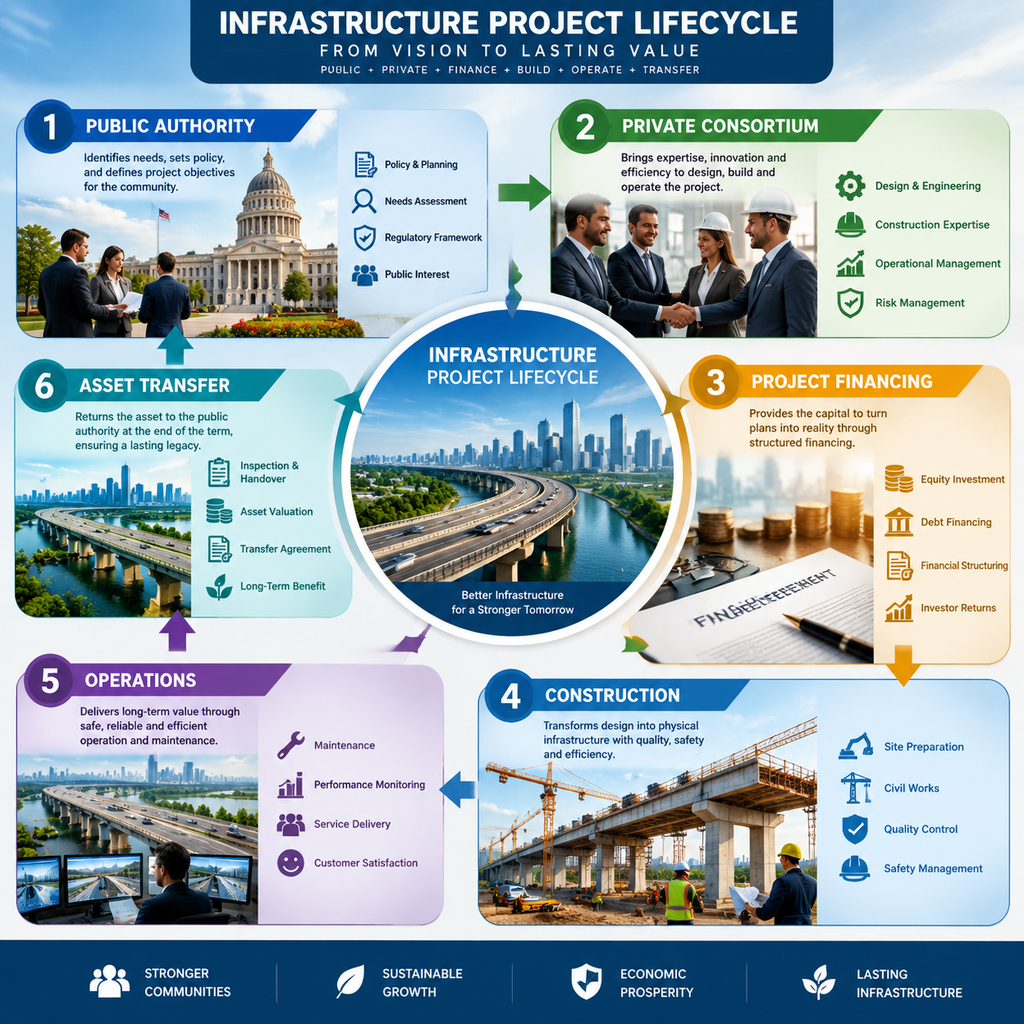
The project type examined here is a greenfield urban expressway developed under a long-term concession agreement — a format common across Southeast Asia, Latin America, and parts of Eastern Europe. The private concessionaire was responsible for design, build, finance, operate, and transfer (DBFOT), with a concession period spanning 30 years.
The public authority retained ownership of the land corridor and provided a partial Viability Gap Funding (VGF) contribution to close the financing gap between projected toll revenues and the capital cost of construction. A special purpose vehicle (SPV) was established by the private consortium to ring-fence project assets and liabilities — standard practice in project finance structures of this scale.
What distinguished this project structurally was the clarity of the concession agreement. The document allocated responsibilities across construction, operations, and maintenance phases with specific output specifications rather than input requirements. This gave the concessionaire flexibility in how it delivered outcomes while holding it accountable for measurable results.
How Risk Was Allocated Between Public and Private Partners
Effective risk allocation assigns each risk to the party best positioned to manage, absorb, or mitigate it — and this project's success was largely built on getting that principle right. Construction risk sat entirely with the private concessionaire, which had both the technical capability and the financial incentive to manage it. Delays cost them money, not the public authority.
Demand risk — specifically traffic volume uncertainty — was handled through a hybrid structure. The concessionaire absorbed demand risk within a defined band. If traffic fell below 75% of the base case projection, the government provided a revenue support payment. If traffic exceeded 125%, a revenue-sharing mechanism returned the surplus to the public authority. This approach, sometimes called a traffic guarantee with cap-and-floor, protected the project's debt service coverage ratio without fully insulating the private partner from performance consequences.
Political and regulatory risk remained with the public authority, which committed to maintaining the tariff adjustment schedule and preventing competing infrastructure from being built within a defined corridor for the first 15 years. These commitments were legally binding under the concession agreement, and their inclusion was a direct result of lender due diligence pushing for clarity before financial close.
The lesson here is uncomfortable but important: risk allocation documents that look balanced on paper often hide asymmetries in enforceability. Practitioners should stress-test every risk clause by asking what actually happens if the trigger event occurs — not just what the contract says should happen.
Financing and Revenue Model That Enabled Long-Term Viability
The financing structure combined senior debt from multilateral development banks, commercial bank lending, and subordinated equity from the private consortium, with Viability Gap Funding from the public authority covering approximately 20% of total project cost. This blended finance approach reduced the cost of capital while distributing financial exposure across multiple parties with different risk appetites.
Viability Gap Funding is particularly worth understanding. VGF is a one-time or phased government grant designed to make commercially unviable but socially necessary projects attractive to private investors. It is not a subsidy in the pejorative sense — it is a mechanism for pricing the public benefit that the revenue model alone cannot capture. In this case, VGF was disbursed in tranches tied to construction milestones, which reduced the government's exposure to projects that stall before completion.
The revenue model relied primarily on user tolls, with a tariff escalation formula linked to a combination of inflation and traffic growth indices. This indexation protected the project's real returns without requiring renegotiation every time macroeconomic conditions shifted — a common source of PPP disputes in projects that fix nominal toll rates for decades.
One trade-off worth acknowledging: the VGF contribution reduced the government's fiscal flexibility. Committing public funds upfront creates opportunity costs, and if the project underperforms, those funds are not recoverable. The VfM assessment conducted before financial close modeled this scenario explicitly, which is why it should be a non-negotiable step in any infrastructure tender process.
Stakeholder Engagement and Regulatory Coordination
Early stakeholder engagement prevented the delays that derail most large transportation PPPs. The project team began community consultation 18 months before the tender was issued, not after contract award. This sequencing matters enormously in practice.
Land acquisition — consistently the single biggest source of delay in greenfield transportation projects — was substantially resolved before the private concessionaire came on board. The public authority absorbed this risk because it was better placed to manage it: it had legal authority, political relationships, and no equity at stake in the construction timeline. Passing land acquisition risk to the private partner in contexts where government action is required to resolve it is one of the most common structural mistakes in transportation PPP tenders.
Regulatory coordination involved establishing a dedicated project oversight unit within the transport ministry, with a mandate to resolve permit bottlenecks within defined timeframes. Lenders required this as a condition of financing. The result was a single point of accountability on the public side — which reduced the coordination overhead that typically fragments decision-making across multiple agencies.
Performance Monitoring and Contract Management Over Time
Performance-based contracts only work if someone is actually measuring performance. This project embedded a performance monitoring framework into the concession agreement from day one, with KPIs covering pavement condition, incident response times, toll collection accuracy, and user satisfaction scores.
Penalties for KPI breaches were calibrated to be meaningful without being destabilizing. A concessionaire facing ruinous penalties for minor service failures has every incentive to dispute measurements rather than fix problems. The penalty schedule in this project was graduated — minor breaches triggered remediation notices, repeated or severe breaches triggered financial deductions, and sustained failures could trigger step-in rights for the public authority.
The concession agreement also included a formal renegotiation window at year 10 and year 20, allowing both parties to adjust terms in response to changes in traffic patterns, technology, or regulatory requirements. This built-in flexibility reduced the pressure to litigate every unforeseen circumstance — and it reflected a realistic understanding that a 30-year contract cannot anticipate every material change in conditions.
Top Lessons Learned and How to Apply Them to Future PPP Tenders
The most transferable lessons from this project are structural, not situational. They apply whether you are bidding on a toll road concession, an urban metro expansion, or an airport PPP.
1. Resolve Land and Permits Before Tender
Issuing an infrastructure tender before land acquisition and key permits are secured transfers unmanageable risk to the private sector and inflates bid prices. Governments that absorb pre-construction risk get better value — and more competitive bids.
2. Build Indexation Into the Revenue Model
Fixed nominal tariffs over multi-decade concessions are a recipe for renegotiation. Link tariff adjustments to transparent, verifiable indices from the outset. This protects the concessionaire's returns and the government's credibility.
3. Use VGF to Close Viability Gaps, Not to Subsidize Poor Structuring
Viability Gap Funding should be sized based on a rigorous VfM assessment, not on what it takes to make a preferred project work financially. If the VGF requirement is very high, the project structure needs revisiting — not just more public money.
4. Align Risk Allocation With Actual Control
Every risk clause should be tested against the question: which party can actually influence this outcome? Risk assigned to a party with no control over the trigger event is not risk allocation — it is a future dispute waiting to happen.
5. Invest in Contract Management Capacity
The public authority's ability to monitor and enforce a performance-based contract is as important as the contract itself. Underfunding the oversight function is the most common way governments lose value in PPPs after financial close.
Frequently Asked Questions
What is the most common reason transportation PPPs fail?
Optimistic traffic forecasts are the leading cause of financial distress in transportation PPPs. When demand projections are inflated to make projects appear viable, the revenue model fails to cover debt service — triggering renegotiation, government bailouts, or project collapse. Robust, independently verified demand studies are a non-negotiable input to any credible concession agreement.
How is risk typically divided between the public authority and the private concessionaire?
Construction risk, operational efficiency risk, and financing risk are typically assigned to the private concessionaire. Land acquisition risk, regulatory and permitting risk, and force majeure events are typically retained by the public authority. Demand risk is often shared through cap-and-floor mechanisms or minimum revenue guarantees, depending on the project's commercial viability.
What is Viability Gap Funding and when is it used in PPP projects?
Viability Gap Funding is a government grant that bridges the gap between a project's financial returns and the investment required to attract private capital. It is used when a project generates significant public value but insufficient commercial returns to be privately financeable on its own — common in urban transit, rural road networks, and social infrastructure PPPs.
How long does a typical transportation PPP concession agreement last?
Transportation PPP concession periods typically range from 20 to 35 years, with toll road and airport concessions often at the longer end. The concession length is usually calibrated to allow the private concessionaire to recover its investment and earn a reasonable return before transferring the asset back to the public authority.
What documents are essential when tendering for a PPP infrastructure project?
The core documents for an infrastructure tender include the Request for Proposal (RFP), the draft concession agreement, the technical output specifications, the VfM assessment, the environmental and social impact assessment, and the financial model assumptions. Lenders will also require an independent technical report and a legal due diligence package before committing to project finance. For practitioners, the World Bank PPP Knowledge Lab provides a comprehensive reference library of standard documentation frameworks used across jurisdictions.