
Public-Private Partnerships in Renewable Energy: Key Trends and Case Studies
Why Renewable Energy Is Driving PPP Growth
Governments cannot fund the energy transition alone. The capital requirements for utility-scale solar, wind, and grid modernization far exceed what public budgets can absorb — which is precisely why public-private partnership frameworks have become the dominant delivery mechanism for new renewable energy infrastructure.
The math is straightforward: the International Energy Agency estimates that clean energy investment needs to reach roughly $4 trillion annually by the early 2030s to stay on track with net-zero pathways. Public finance can anchor deals and absorb risks that markets won't touch, but private capital has to do most of the heavy lifting.
PPP structures give governments a way to transfer construction and operational risk to the private sector while retaining policy control over tariffs, grid access, and long-term energy planning. For private investors, the PPP model provides regulatory certainty and a defined revenue framework — usually through a Power Purchase Agreement — that makes project finance feasible.
The result is a structural alignment of incentives that works reasonably well when deals are designed carefully. When they're not, the misalignments tend to be expensive.
Common PPP Models Used in Renewable Energy Projects
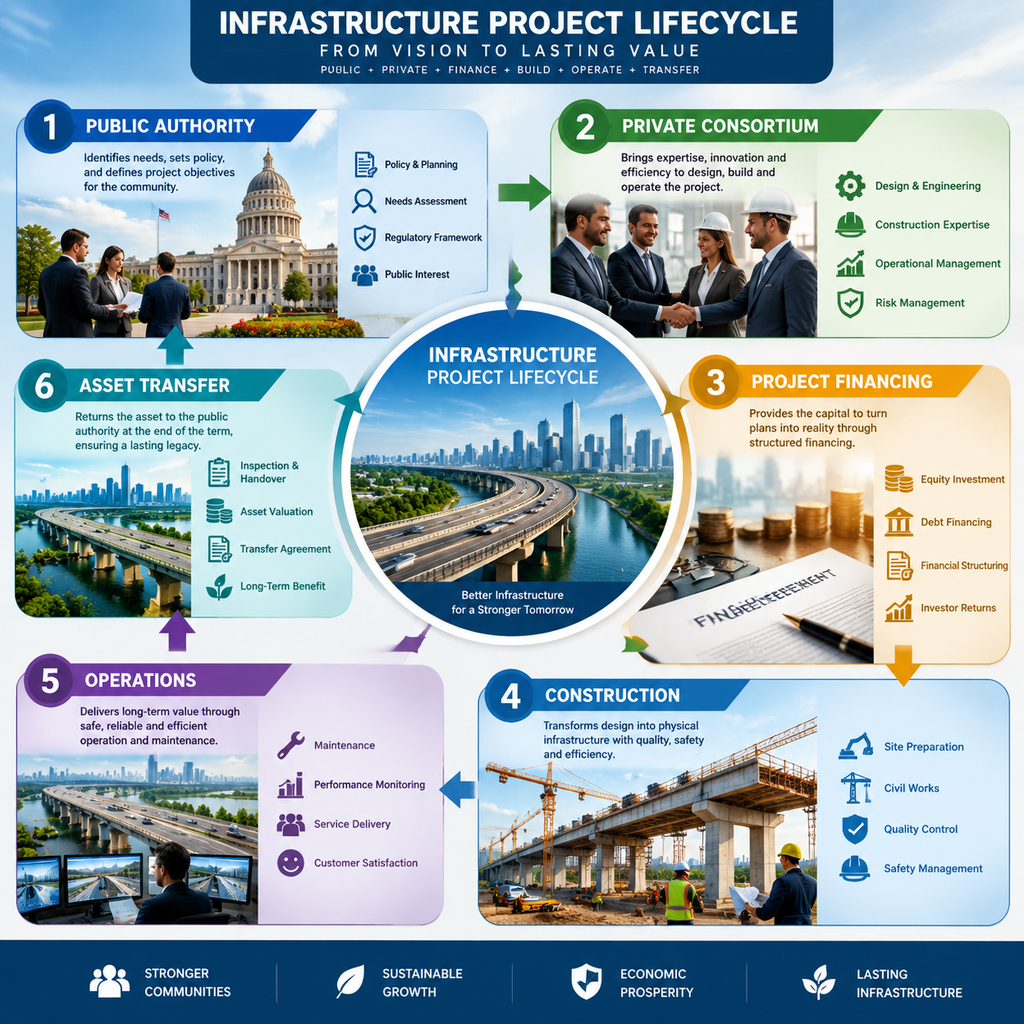
The most widely used PPP structures in renewable energy are concession agreements, build-operate-transfer arrangements, and hybrid models that blend elements of both. The choice between them is not cosmetic — it determines who owns the asset, who bears operational risk, and how revenue flows for the life of the project.
A concession agreement grants a private developer the right to build, own, and operate a renewable energy facility for a fixed period — typically 20 to 30 years — after which ownership may revert to the state. This model is common in utility-scale solar and wind projects in emerging markets, where governments want private capital and expertise but intend to reclaim strategic infrastructure over time.
The build-operate-transfer (BOT) model follows a similar logic but with a cleaner ownership transition built into the original contract. The private party finances, builds, and operates the facility, recovers its investment through tariffs or PPA revenues, then transfers the asset at the end of the concession. BOT is frequently used in grid interconnection and transmission projects where the public interest in long-term ownership is strongest.
Hybrid models are increasingly common in more complex projects — offshore wind platforms with grid integration components, for instance, often split the concession across generation (private) and transmission (public or jointly owned). This reflects the reality that different parts of the same project carry different risk profiles and attract different investor classes.
How Risk Is Allocated Between Public and Private Partners
Risk allocation is the core engineering challenge of any PPP deal. The general principle is that each risk should sit with the party best positioned to manage or absorb it — but in practice, negotiations are as much about leverage as they are about logic.
Construction risk almost always falls to the private developer. The contractor takes responsibility for cost overruns, delays, and technical performance through fixed-price EPC contracts and performance bonds. Lenders require this as a condition of project finance.
Offtake risk — the risk that the project cannot sell its power at a price that covers debt service and returns — is where government involvement becomes critical. A bankable PPA with a creditworthy public utility or government offtaker essentially transfers this risk to the state. Without it, most renewable energy projects in emerging markets cannot attract non-recourse debt. Where sovereign creditworthiness is weak, partial risk guarantees from multilateral institutions or Viability Gap Funding mechanisms can plug the gap.
Currency risk is a persistent challenge in cross-border and emerging market projects. Renewable energy revenues are often denominated in local currency while project debt is in USD or euros. Hedging instruments exist but add cost; some PPP structures address this by indexing tariffs to exchange rates, shifting currency exposure to the offtaker.
Regulatory and political risk — permit changes, tariff renegotiation, grid access disputes — is typically handled through stabilization clauses in concession agreements and, for larger deals, investment treaty protections. Getting these provisions right at the drafting stage matters more than most developers realize until something goes wrong.
Financing the Deal — The Role of Project Finance and MDBs
Renewable energy PPPs are almost universally structured as project finance transactions, meaning debt is secured against project cash flows rather than the balance sheet of the sponsors. This non-recourse or limited-recourse structure protects sponsors but requires the project itself to be financially robust enough to service debt independently.
Typical leverage ratios in utility-scale renewable PPPs run between 70:30 and 80:20 debt-to-equity, depending on market risk, offtaker quality, and technology. The PPA is the central bankability document — lenders will stress-test every clause, and a weak or ambiguous offtake agreement will either kill the deal or drive up the cost of debt significantly.
Multilateral Development Banks play a catalytic role that goes beyond their direct lending. Institutions like the IFC, the Asian Development Bank, and the African Development Bank bring three things to a deal: concessional or below-market financing that improves project economics, political risk cover that commercial lenders won't provide on their own, and a signaling effect that encourages other lenders to participate.
Blended finance structures — where MDB concessional funds are combined with commercial debt and equity — have expanded the universe of bankable projects in markets that would otherwise be too risky for private capital alone. The trade-off is deal complexity and longer preparation timelines. Transactions that involve multiple MDB co-lenders can take two to three years from mandate to financial close.
Notable Trends Reshaping the PPP Landscape
The structure of renewable energy PPPs is evolving faster than the standard contract templates suggest. Several trends are reshaping how deals are designed, tendered, and financed.
- Battery storage integration: Increasingly, storage components are being bundled into generation concessions rather than procured separately. This changes the risk profile significantly — storage adds capital cost and introduces technology performance risk that traditional PPA structures weren't designed to price.
- Cross-border energy corridors: Regional transmission PPPs, particularly in Southeast Asia, East Africa, and the Western Balkans, are creating new contractual complexity as projects span multiple regulatory jurisdictions. Intercountry frameworks and revenue-sharing mechanisms between state utilities are still being worked out in many of these corridors.
- Green procurement requirements: Tender documents now routinely include sustainability conditions — domestic content requirements, environmental impact thresholds, community benefit obligations. These add compliance cost but are increasingly non-negotiable in European and multilateral-funded tenders.
- ESG criteria in partner selection: Beyond project-level environmental standards, procuring authorities are applying ESG screens to the developers and investors themselves. Track record on labor practices, anti-corruption compliance, and climate disclosure is becoming part of prequalification, not just a box-ticking exercise.
Illustrative Case Study Types Worth Examining
Rather than relying on a single flagship example, professionals evaluating or bidding on renewable energy tenders benefit more from studying a range of deal archetypes that represent different risk environments and structural choices.
Utility-scale solar concessions in emerging markets are instructive because they typically involve the full stack of PPP complexity: sovereign creditworthiness challenges, VGF mechanisms, MDB co-financing, and currency risk management. The gap between financial close and commercial operation in these deals reveals a lot about how well the original risk allocation held up under implementation pressure.
Offshore wind PPPs in Northern and Central Europe represent a more mature model, with competitive tender processes, standardized PPA structures, and deep capital markets participation. What makes them worth studying is the evolution from fully government-supported deals in the early 2010s to subsidy-free or negative-subsidy bids more recently — a shift driven by technology cost reduction and increasingly sophisticated risk pricing by developers.
National grid modernization programs structured as PPPs offer a different lens entirely. These deals often involve regulated asset base (RAB) models rather than PPAs, with revenue certainty provided through regulated returns rather than offtake contracts. Understanding how transmission and distribution PPPs differ from generation-side structures is useful for any professional working across the energy infrastructure value chain.
What Makes a Renewable Energy PPP Succeed
Successful renewable energy PPPs share a small number of structural characteristics that are identifiable before financial close — which means they're also things developers, lenders, and procuring authorities can actively design for.
Transparent and competitive tender processes matter more than most market participants admit. When procurement is opaque or politically influenced, the developers who win are not necessarily the ones who can execute best. That erodes long-term project performance and discourages serious bidders from investing in future tenders.
A bankable PPA structure is non-negotiable. This means a creditworthy offtaker, clearly defined dispatch obligations, force majeure provisions that don't leave the developer holding every residual risk, and payment security mechanisms — escrow accounts, letters of credit, or government backstops — that give lenders confidence in cash flow reliability.
Institutional capacity on the public side is an underrated factor. Government agencies that understand project finance, can negotiate commercially, and have the authority to honor contractual obligations consistently produce better deal outcomes than those that don't — regardless of how attractive the underlying energy resource is.
Finally, political risk mitigation through investment treaties, arbitration clauses, and MDB participation is what allows long-tenor project finance to work in higher-risk markets. Developers who underinvest in these protections at the structuring stage often find themselves without adequate remedies when regulatory conditions shift years into a 25-year concession.
Frequently Asked Questions
What is the difference between a PPP and a standard government energy procurement?
In a standard procurement, the government funds, owns, and operates the energy infrastructure itself. In a PPP, a private developer takes on financing, construction, and operational responsibilities in exchange for a contractually defined revenue stream — typically through a PPA or regulated tariff. The key distinction is risk transfer: PPPs shift financial and performance risk to the private sector, while standard procurement keeps that risk with the public balance sheet.
How is offtake risk typically handled in a renewable energy PPP?
Offtake risk is usually managed through a long-term Power Purchase Agreement with a public utility or government-backed offtaker. The PPA locks in a tariff for the life of the project, giving lenders the revenue certainty they need to finance the deal. In markets where the offtaker's credit is weak, government payment guarantees, escrow mechanisms, or partial risk guarantees from MDBs are used to strengthen the offtake structure.
What role do multilateral development banks play in these projects?
MDBs provide concessional debt, political risk insurance, and partial risk guarantees that make projects bankable in markets where commercial finance alone isn't sufficient. Their participation also serves as a signal to other lenders that the project meets minimum governance and environmental standards — which can materially reduce the cost of commercial debt alongside their own facilities.
Can small or mid-sized companies participate in renewable energy PPP tenders?
Yes, though the path depends on the tender structure. Large utility-scale concessions typically require financial and technical prequalification thresholds that favor established developers. Smaller companies often participate through consortium structures — joining as EPC contractors, minority equity partners, or specialists in a particular technology component. Some governments are also designing smaller-scale tender programs specifically to broaden market participation.
What are the most common reasons renewable energy PPPs fail or stall?
The most frequent causes are weak offtake creditworthiness that prevents financial close, regulatory changes that undermine project economics after bid submission, grid connection delays that extend construction timelines and increase debt service costs, and poorly drafted force majeure or termination provisions that leave the deal unresolvable when disputes arise. Currency depreciation in markets where tariffs are local-currency-denominated but debt is hard-currency has also derailed a significant number of projects in recent years.